
Row Gaps & Stand Uniformity
A few years ago when I started scouting, two of my customers had just picked up new seed drills. That spring we had several discussions about depth, fan speed, and emergence patterns.
For one customer, the new drill had consistent placement along the row and in some areas the stands were a bit above target.
In the other case, the stand counts aligned better with our target range, but certain areas looked spottier than others. We agreed that a manual stand count wasn't sufficient for measuring this beyond a qualitative description of 'looks spotty' or 'looks good'.
Manual Sampling Bias
The effect of bias in manual sampling can be seen by this second case.
Was our stand in target range, or was I biased toward counting nicer areas?
Was this issue related to equipment or soil conditions?
How much did gaps affect yield, and how did that vary across the farm?
To collect uniformity or gap data manually to answer these questions, you would need to measure the distance between each plant which isn’t common in small grain production.
Uniformity - Plant Spacing Error Metrics
There are many ways to measure crop uniformity. The approach I used when I managed small plot research trials was a simple 1-10 rating for each plot. But for larger fields and between agronomists, this approach can be subjective and starts to fall apart.
By using image data to detect plant locations along the row, we can measure how seeding rate, equipment settings, and fertilizer rates/placement affect uniformity. This gives us a wider perspective than average density (plants/ft²) for stand quality - providing insight on where we can improve total canopy light interception, weed competition, water/fertility use, and more.
The two uniformity metrics that are delivered in our CSV exports are plant spacing MAE and RMSE. These two are calculated for each row, so cross-drill performance can be evaluated. We roll up these row-level stats to photo, zone, and field levels, showing how these patterns change across the farm/operator.
MAE is a value given in inches, which indicates the average error from ideal spacing given the total number of plants in a row. MAE of 2.5 means that on average each plant is 2.5” away from consistent row spacing - lower is better.
RMSE is a similar value, but penalizes larger errors more harshly so this metric can be more useful in filtering areas with the worst uniformity for further investigation.
Row Gaps - Seeded Rows with No Plants
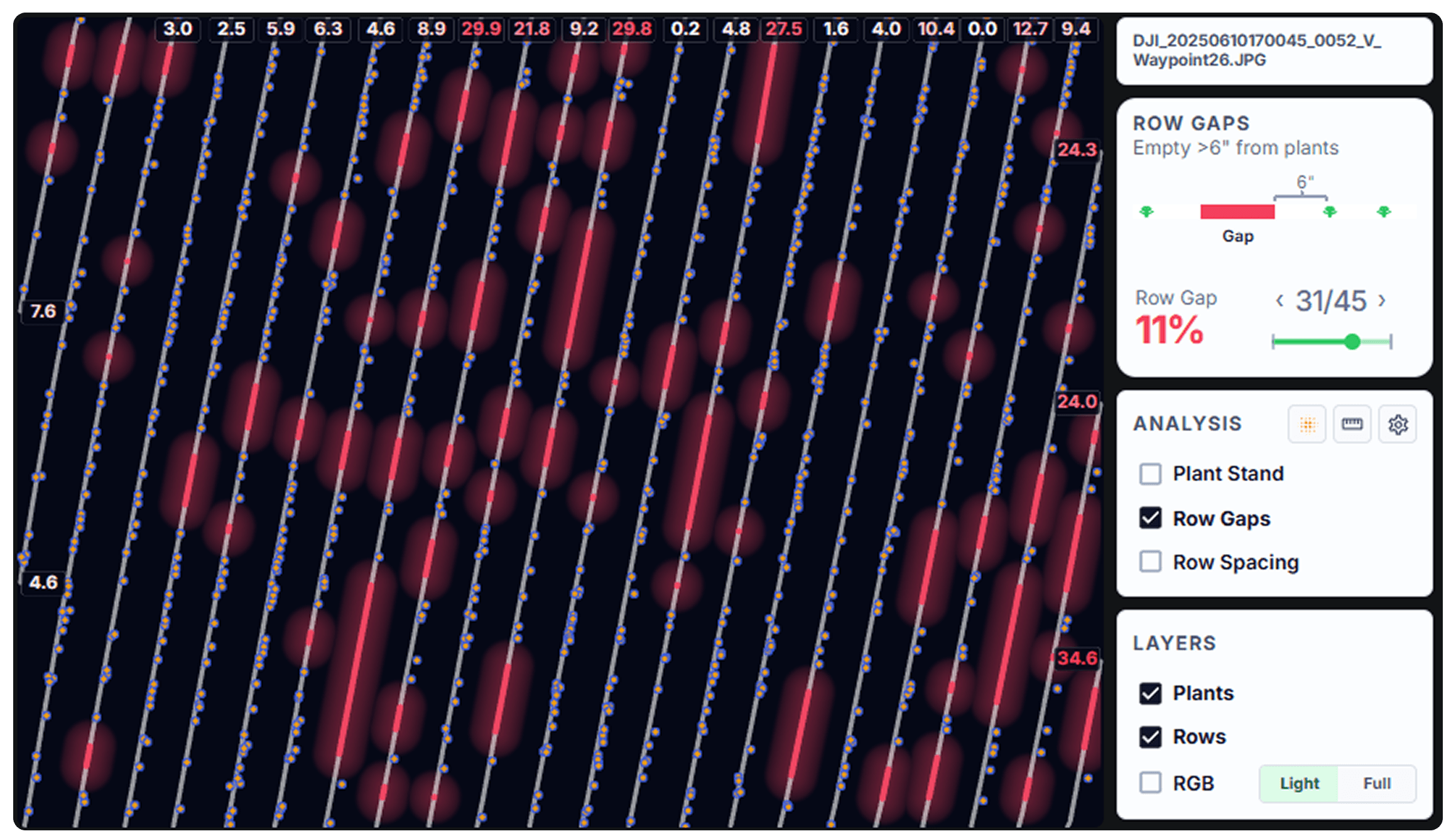
Gaps in emergence along rows can result from high seedling mortality caused by seeding conditions or from issues with seeding equipment. In the same way as with poor uniformity, row gaps lead to a less efficient use of moisture and fertility, and they allow for light to reach the soil to support weed growth without crop competition.
To measure gaps, we snap each plant position to the nearest pixel on its assigned row, and we measure row segments that are more than 6 inches from any plant in that row.
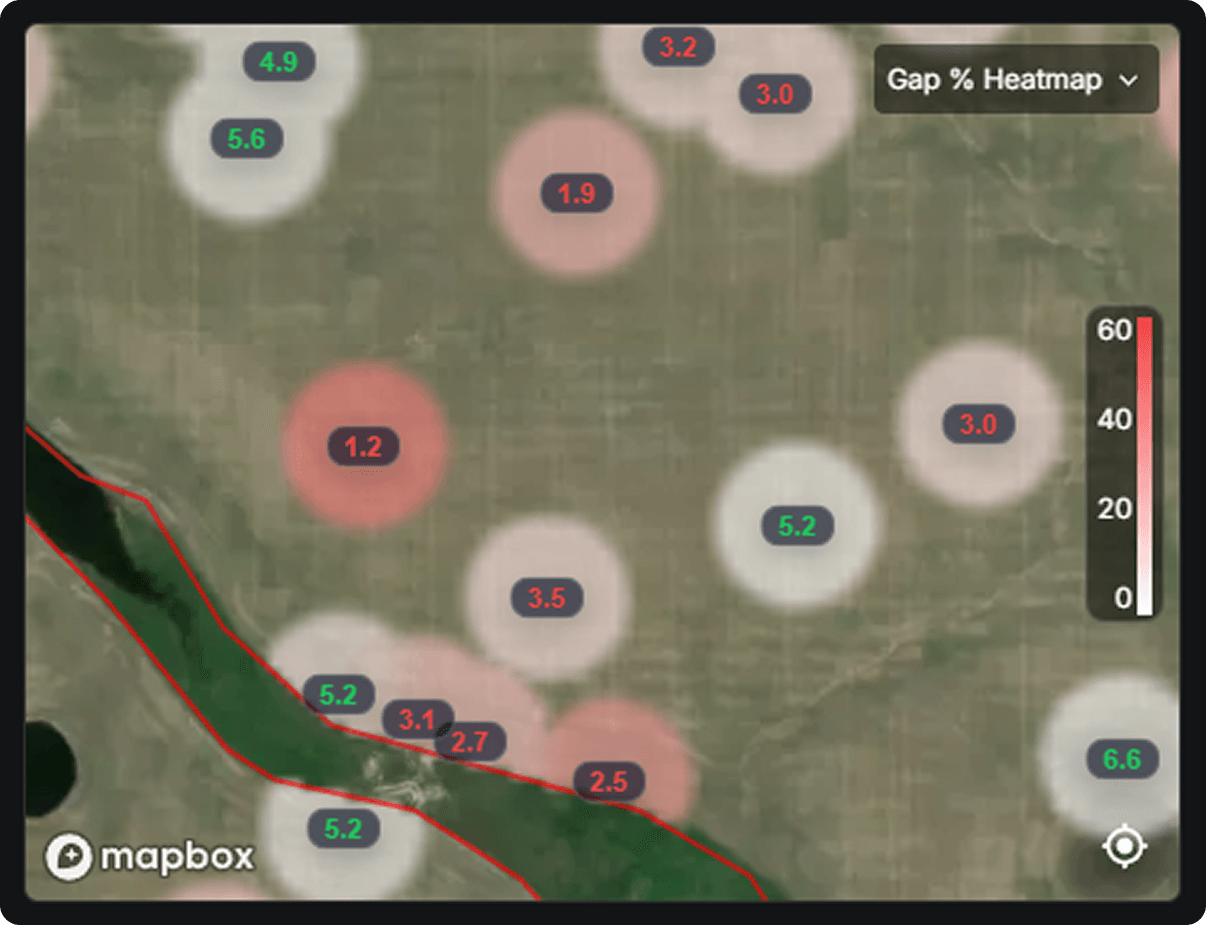
This gives us an exact quantitative metric in % and length, so we can track how this changes across seeding conditions, crop type, soil zones, and fields.
Article highlights
Row Gaps
Length of row >6" from plants
MAE + RMSE
Uniformity outputs
Row › Photo › Zone › Field
Export CSV files
PlantCounts
Reliable stand data without hours of manual counting.
Built for agronomy in Saskatchewan.
© 2026 NovaScout. All rights reserved.